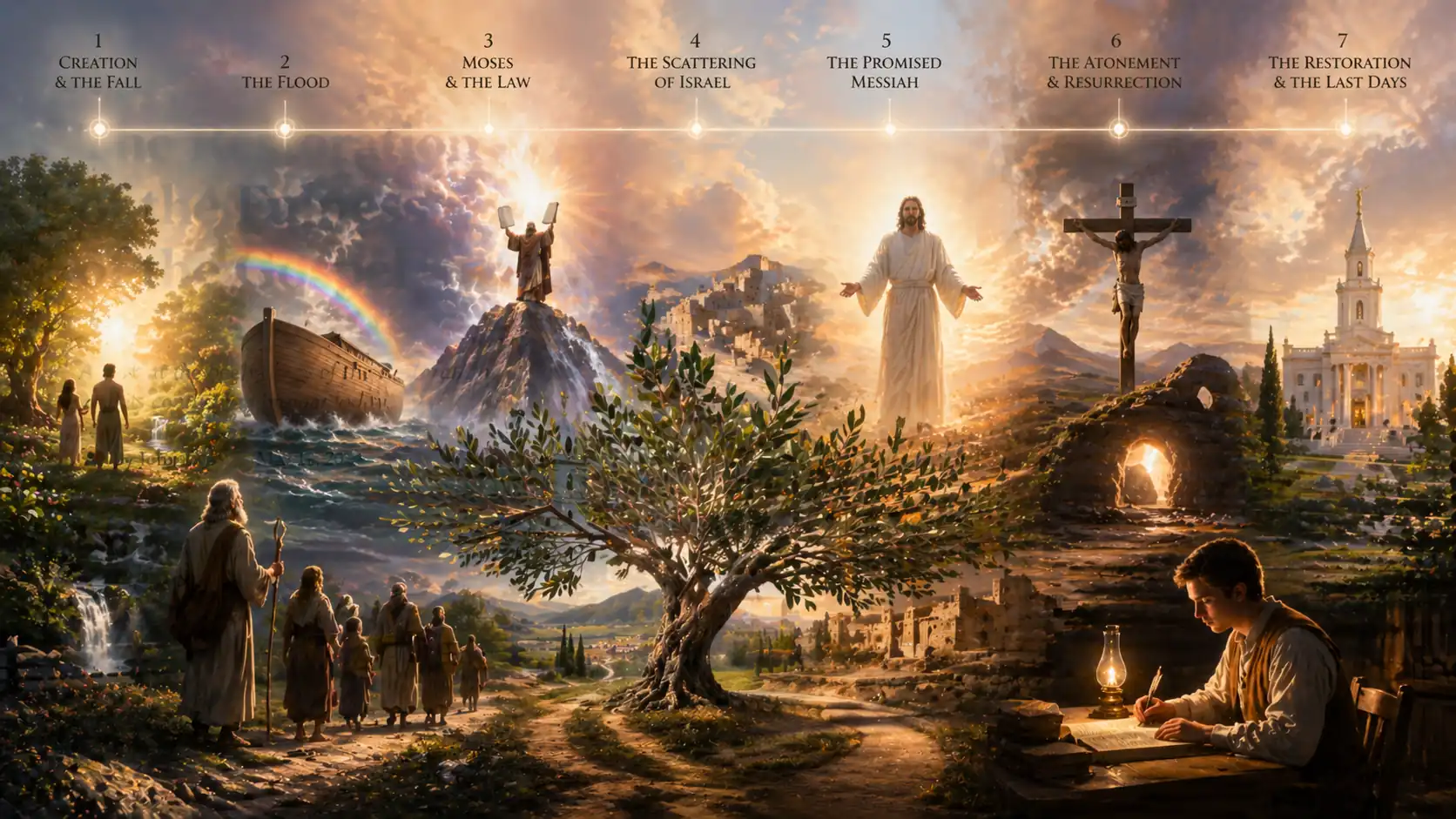
If you open your Book of Mormon today, you’ll see that the First Book of Nephi has 22 chapters. But did you know it wasn't always like that? When Joseph Smith dictated the translation in 1829, the text flowed continuously. It was the scribes and the printer who, guided by the natural pauses in the original narrative, marked the chapters. In that very first 1830 edition, Nephi’s record was organized into exactly 7 chapters.
For the ancient Israelites, the number seven wasn't just another digit; it was the ultimate symbol of perfection, covenants, and wholeness. Furthermore, in Restoration scripture (like Doctrine and Covenants 77:6), the number seven represents the seven thousand years of the earth's temporal history.
When we look closely at those 7 original chapters, we discover something absolutely mind-blowing: 1 Nephi is not just a teenager’s journal about a trip through the desert. It’s a divine "map of time," where each chapter perfectly mirrors a specific millennium of human history. Let’s break down this incredible architectural design and look at what scholars have uncovered about it.
Chapter I (1 Nephi 1–5)
The first millennium is the era of the Creation and the Fall of Adam and Eve. Fascinatingly, Lehi’s journey kicks off with those exact same cosmic themes.
The story opens with pure creation imagery: Lehi sees a being whose luster is brighter than the "sun at noonday" and others who shine brighter than the "stars" (1 Nephi 1:9-10). Then, just as God caused a "deep sleep" to fall upon Adam before initiating the next phase of humanity, the family’s entire journey truly begins when Lehi is overcome by the Spirit, "cast himself upon his bed" (1 Nephi 1:7), and enters a deep visionary state.
As researcher Christina Dymock points out, Lehi and Sariah act here as a new Adam and Eve. They have to leave a life of comfort and abundance in Jerusalem (their own "Edenic" state) to be cast out into a lone and dreary wilderness where survival requires sweat and tears. Legendary LDS scholar Hugh Nibley documented in Lehi in the Desert how Lehi leaves a corrupt civilization to get back to basics, becoming the pioneer of a new world.
Nephi even gives us an inventory of what they left behind: "his gold, and his silver, and his precious things" (1 Nephi 2:4). This is a huge clue; it sounds exactly like Genesis 2’s description of Havilah, the lands rich in gold and precious stones that bordered the original Garden of Eden. To seal this connection, Nephi closes this section by explaining exactly why his brothers murmured: because "they knew not the dealings of that God who had created them" (1 Nephi 2:12). Of all the names for God, Nephi deliberately chooses "Creator."
Chapter II (1 Nephi 6–9)
The second millennium is the era of Noah. Here, the story shifts from "being cast out" to "being preserved" from imminent destruction.
Nephi uses highly specific vocabulary when warning his brothers about the fall of Jerusalem, telling them that "the Spirit of the Lord ceaseth soon to strive with them" (1 Nephi 7:14). That is the exact same warning God gave in Genesis 6:3 right before sending the flood.
But the most fascinating parallel comes from modern archaeology. Non-LDS scholar Esther Eshel, analyzing the Genesis Apocryphon (an ancient text from the Dead Sea Scrolls), discovered that ancient peoples believed Noah received symbolic dream-visions about trees to understand how God would save the righteous. And what do we find sitting right in the middle of this chapter? Lehi’s dream of the Tree of Life.
Surrounded by a "dark and dreary waste" and a river of filthy water sweeping away the wicked (a clear representation of a flood of chaos and sin), Lehi sees a glowing tree offering refuge. Just like Noah, Lehi uses his dream to plead with his family to hold onto the iron rod and get on the "ark" before the world drowns them.
Chapter III (1 Nephi 10–14)
We now reach the third millennium: the time of Moses, the great prophet of the mountain. If we read the Book of Moses in the Pearl of Great Price, we know he was "caught up into an exceedingly high mountain" where he spoke with God face to face.
Nephi experiences his own exact version of this. In this chapter, he tells us he was "caught away in the Spirit of the Lord, yea, into an exceedingly high mountain" (1 Nephi 11:1). There, the Spirit speaks to him directly, "as a man speaketh with another." Margaret Barker, a British theologian famous for her temple studies, explains that ancient mountain ascents were literally "temple endowment experiences" where prophets received the secrets of the universe.
From that peak, God shows Nephi the entire panoramic blueprint of history: the birth of Jesus, the great divide between the Church of the Lamb and the church of the devil, and the destiny of his posterity. Nephi comes down from that mountain as a "new Moses" for his people, armed with divine knowledge and prophetic authority.
Chapter IV (1 Nephi 15)
The fourth millennium is a time of massive historical trauma: the scattering of Israel by the Assyrian and Babylonian empires.
Imagine being in Laman and Lemuel's shoes. They are suffering from severe cognitive dissonance. They blindly believe the false popular theology of their day—that Jerusalem is indestructible simply because Solomon's Temple is there. They are in total denial that they are refugees fleeing the impending invasion of King Nebuchadnezzar.
To break through that denial and help them heal, Nephi pulls out one of the deepest teachings from the brass plates: Zenos’s allegory of the olive tree. Nephi tells them: "Behold, are we not broken off from the house of Israel, and are we not a branch of the house of Israel?" (1 Nephi 15:12). Scholars like David Rolph Seely have noted how this allegory was the perfect tool for the era. Nephi helps them see they aren't just victims of geopolitics or random nomads; they are a "branch" the Lord of the vineyard is intentionally planting elsewhere to preserve the covenant. Their family crisis fits perfectly into the era of the global scattering.
Chapter V (1 Nephi 16–19)
The fifth millennium marks the climax of human history: the Atonement of Jesus Christ.
It’s incredibly telling that, up to this point, Nephi had avoided giving graphic details about the Savior's death. Even in his grand mountain vision, he focused on Christ's birth and ministry. But here, exactly in the fifth structural position, Nephi breaks his silence.
He quotes ancient prophets (Zenos, Neum, and Zenock) to reveal that the world would "scourge him," "smite him," and "spit upon him" (1 Nephi 19:9). He describes something terrifying: how nature itself would spiral into chaos—rocks rending and three days of darkness—as it witnessed the death of the God of nature. Nephi deliberately saved the theological weight of eternity's most painful and important event for the exact millennium in which it would occur.
Chapter VI (1 Nephi 20–21)
The sixth millennium is our time. Here, the darkness of the scattering and the crucifixion is left behind, and Nephi's voice fills with hope and triumph.
Instead of using his own words, Nephi transcribes chapters 48 and 49 of Isaiah. As LDS scholar Joseph Spencer explains, Nephi is a master at adapting Isaiah. He uses these chapters to describe a future time when the Lord would proceed to do a "marvelous work" and "set up [His] standard to the people" (1 Nephi 21:22). He speaks of how the "Gentiles" will bring the restored gospel back to Lehi's descendants. It’s a direct prophecy about the coming forth of the Book of Mormon and the dawn of our current dispensation.
Chapter VII (1 Nephi 22)
Finally, this breathtaking clockwork design culminates in the seventh millennium: the thousand years of peace following the Second Coming.
In this final chapter, the tension between good and evil completely resolves. Nephi prophesies that "Satan has no power" and that the righteous will be fed and protected "as calves of the stall" (1 Nephi 22:24, 26). That last phrase is powerful; it evokes an image of animals completely safe from predators (Satan), perfectly cared for by their master (Christ). Evil is purged, and humanity finally enters the rest of the Lord.
Conclusion
When we read 1 Nephi through this lens, it completely shifts our paradigm. It isn’t just an inspiring story about an obedient teenager; it is an architectural masterpiece, a coded revelation. From the echoes of Adam and Eden in the first millennium, through Lehi's "ark," the Moses-like mountain, the Babylonian scattering, the brutality of the crucifixion, straight to the Restoration and the Millennium, the text flows with supernatural precision.
This hidden structure is no accident. It is a tangible witness to our generation that the Lord is the Master Architect, that He truly "knows the end from the beginning," and that His master plan has always been encoded into the very foundations of the Book of Mormon.

Juan Sebastian Gonzalez Lopez
I'm a software engineer, but my favorite code is found in ancient texts. I love doing 'surgery' on the Book of Mormon and the Bible: taking verses apart, exploring their Semitic roots, and seeing how they work on the inside. I write to help you discover that the scriptures are deeper, more real, and way cooler than you might think.